Geomechanics · Agentic AI · Numerical modelling
Geomechanics models, built faster with AI and reviewed by a specialist.
AIM Consulting Associates is a Canadian company building agentic AI workflows and numerical models for rock slopes, faults and fluid pressure in mining and energy.
Incorporated in British Columbia, Canada, 2025.
What we do
Three disciplines, one accountable result.
-
01
Agentic AI
Software agents that carry out the repetitive parts of an engineering analysis: gathering and checking inputs, building and running models, and drafting results. Every step is logged, so a person can trace it, question it and run it again.
-
02
AI modelling
Machine-learning models tested against physics and against data they have not seen, used where they add speed or reveal a pattern, and reported with their uncertainty rather than as a single confident number.
-
03
Numerical modelling
Stress, deformation and fluid-pressure models of rock masses, slopes and faults, from closed-form screening calculations to full numerical simulation, with the assumptions written down.
Demonstration
A fault behind a slope, under stress.
A small, working example of how we approach a problem: a published calculation, implemented from first principles, tested, and drawn in three dimensions. Every number in it is invented.
Synthetic data, not a model of any real site
Raised fluid pressure (qualitative, not predictive)
-
1 · The model
A slope, cut open.
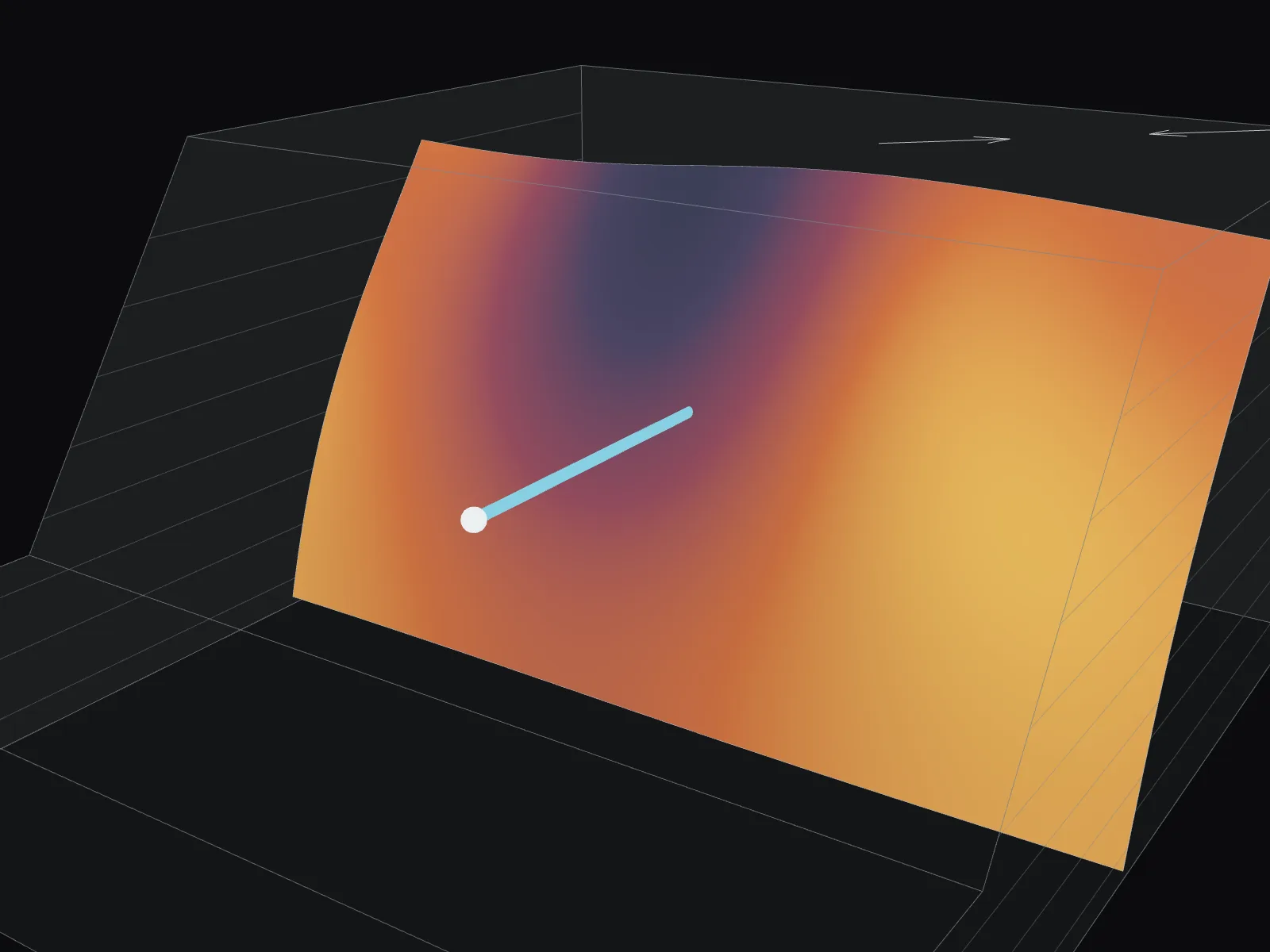
A synthetic rock slope drawn as a transparent block, with a curved fault behind its face. Because the fault bends, its orientation changes from place to place, and so does the stress acting on it.
-
2 · Slip tendency
Where is it closest to sliding?
Colour shows slip tendency: the shear stress on the fault divided by the effective normal stress clamping it shut (Morris and others, 1996). Amber patches are oriented closer to sliding under this stress field; blue patches are held more firmly.
-
3 · Fluid pressure
A borehole adds fluid.
A horizontal borehole runs from the slope face to the fault. Pumping fluid into it raises the pressure on the fault nearby, which reduces the stress clamping the fault shut. The blue halo shows where pressure is raised. It is qualitative: it shows where, not how much.
-
4 · Dilation tendency
Where would it open?
Dilation tendency compares the normal stress on each part of the fault with the largest and smallest principal stresses (Ferrill and others, 1999). High values mark the parts most easily opened, which tend to carry fluid.
In plain language
The same fault can be close to slipping in one place and firmly locked a short distance away, simply because its surface turns relative to the stress. Raising fluid pressure moves parts of it closer to slipping, and where pressure exceeds the stress holding it shut, it opens. Seeing that pattern early helps decide where to look harder, and what to measure.
Synthetic inputs and equations
- Maximum horizontal stress
- 19.5 MPa, toward 45°
- Vertical stress
- 13 MPa
- Minimum horizontal stress
- 9.1 MPa
- Ambient pore pressure
- 4.9 MPa
- Slip tendency
- shear stress / (normal stress − pore pressure)
- Dilation tendency
- (σ1 − normal stress) / (σ1 − σ3)
- Status
- All values invented. Equations checked against an independent reference implementation.
How we work
AI does the legwork. A specialist owns the answer.
Agents make analysis faster and more repeatable. They do not replace professional judgment, so every piece of work passes through the same four stages.
- 01 · Define
The problem and the data
Agree the question, the data available and what a defensible answer has to show.
- 02 · Assist
Agents prepare and run
Agents prepare data, build and run models, and draft the analysis, with every step recorded.
- 03 · Check
Tests that can fail
Results are checked against known solutions and sensitivity runs, using tests designed to fail when something is wrong.
- 04 · Review
A specialist reviews
A geomechanics specialist reviews the work and is accountable for the conclusions that leave the company.
Contact
Start a confidential technical conversation.
Tell us about the problem, the data you have and the decision it needs to support.
info@aimconsultingassociates.comWhat you send is used only to reply to you and is not shared. See the privacy notice for how messages and form submissions are handled.
Writing to us
A short email is enough to start. If you can, include:
- the site type and the question you need answered;
- the data that exists today (for example logs, surveys, monitoring or models);
- the decision the answer will inform, and when it is needed;
- any confidentiality requirements, so we can agree terms before you share data.